
Keywords
Abstract
Zn and Mg antimonides are positioned as effective thermoelectric materials for thermoelements with operating temperatures from 300 to 800 K. Optimal compositions, doping, and methods for producing thermoelectric materials have been established. The p-type β-Zn4Sb3 has the maximum dimensionless thermoelectric figure of merit ZT of 1.40–1.57 and average ZT up to 1.10 in the range of 300–720 K. Maximum ZT of thermoelectric materials on the basis of n-type Mg3Sb2 is 1.65–2.00, with average ZT of 1.20–1.36 in the range of 300–800 K. Maximum ZT of p-type MgAgSb is 1.50, with average ZT of 1.31 in the range of 300–573 K. Practical application of thermoelectric materials is limited by the difficulty of obtaining a single-phase material. Another significant problem is their thermal instability.
1. Introduction
A promising trend in the development of thermoelectric engineering is designing of autonomous electrical power sources based on thermoelectric generators (TEGs) [1-3]. TEGs are indispensable sources of electrical power for spacecraft used for the exploration of deep space and the far side of the Moon [4-9]. It should also be noted that TEGs are used as the power supply systems of modern military and civilian ships equipped with next-generation nuclear power plants. The development of autonomous electrical power sources based on TEGs is of considerable importance for the development of remote regions of the Far North, including the Northern Sea Route, the Russian Far East, and other areas isolated from centralized power supply systems. In this regard, it is necessary to emphasize the particular importance of developing autonomous small-capacity nuclear power plants (SCNPPs) equipped with TEGs for heat and electricity supplying of settlements and other facilities. TEGs are reliable sources of electrical power that provide a long maintenance-free service life, significantly exceeding the service life of fuel cells or batteries [5, 9, 10].
The widespread application of TEGs is limited by their low efficiency, which is largely determined by the low thermoelectric figure of merit of the semiconductor thermoelectric materials used for the fabrication of thermoelements employed in TEGs [11-14]. Bi2Te3-based thermoelectric materials are the most efficient in the temperature range of 200–600 K and are the most widely used materials for this temperature range [12, 15]. By varying the stoichiometry and charge-carrier concentration, materials on the basis of Bi2Te3 with a high thermoelectric figure of merit up to temperatures of 600 K are obtained [12, 15, 16]. In particular, the development of thermoelectric modules for SCNPPs requires thermoelectric materials with the maximum of thermoelectric figure of merit in the temperature range of 300–700 K. Zinc- and magnesium-based antimonides are promising materials exhibiting high thermoelectric performance within the specified temperature range and have been actively investigated in recent years.
In this regard, the purpose of this work is to analyze the challenges and achievements in the development of efficient thermoelectric materials on the basis of zinc and magnesium antimonides and to determine their optimal compositions, doping, and fabrication methods.
2. Zinc antimonide based materials
Zinc antimonide exists in three polymorphic modifications, α, β, and γ, which are stable below 263 K, within the temperature range of 263–767 K, and above 767 K, respectively. Thus, the β-phase (β-Zn4Sb3) is the most attractive for application in thermoelectric generator thermoelements operating at temperatures up to ~700 K. The structural features of β-Zn4Sb3 allow it to be classified as a material that corresponds to the “phonon-glass–electron-crystal” concept. This concept was proposed in 1995 [17]. Its significance is connected with the development of highly efficient thermoelectric materials possessing glass-like low thermal conductivity while simultaneously exhibiting, like crystalline semiconductors, high electrophysical properties.
The structure of the material shows a noticeable disorder in the arrangement of Zn atoms. Thus, the presence of Zn atoms induces in a significant number of defects and low lattice thermal conductivity. At the same time, β-Zn4Sb3 is a degenerate semiconductor material, which explains for its high electrophysical properties. This unique structural configuration provides low thermal conductivity (κ) of 0.36 W/(m·K) [18] while maintaining high electrophysical properties. β-Zn4Sb3 has a band gap of 0.8 eV, which allows this material to retain high thermoelectric performance at elevated temperatures. Its electrical conductivity (σ) can be significantly increased by doping with Ga and Al.
The polymorphic modification of zinc antimonide corresponding to the β-phase (β-Zn4Sb3) is a p-type semiconductor with a hexagonal crystal structure belonging to the R3c space group. The random distribution of interstitial Zn atoms (Znᵢ) effectively reduces the phonon mean free path, significantly decreasing the thermal conductivity. The relatively wide band gap of β-Zn4Sb3 promotes the high values of the Seebeck coefficient (s). At the same time, good electrical conductivity is determined by a robust Sb structure that ensures high charge-carrier mobility. As a result, the favorable combination of low thermal conductivity and a high power factor (PF = s2σ) in β-Zn4Sb3 ensures a high thermoelectric figure of merit (ZT = s²σT/κ). The absence of expensive and toxic elements, such as Te, one of the main components of efficient thermoelectric materials, improves the economic efficiency and environmental friendliness of Zn4Sb3, which determines its high potential for widespread practical application in thermoelectric technology.
In recent years, the use of advanced technologies has made it possible to significantly improve the thermoelectric parameters of β-Zn4Sb3 and to achieve maximum values of the dimensionless thermoelectric figure of merit (ZT)max, exceeding 1.
In [18], β-Zn4Sb3 was investigated. Zinc antimonide was synthesized by direct melting through heating to 1023 K for 8 h, followed by holding at this temperature for 14 h and subsequent water quenching. Then, part of the synthesized material was processed by the Bridgman method to obtain a single-crystal sample at a temperature of 873 K and a growth rate of 2.3 mm/h. The other part was cooled in the furnace for 5 days to obtain a polycrystalline sample. For the single-crystal sample, higher values of mobility and concentration of charge carriers were observed, which determined high electrical conductivity. The Seebeck coefficient of the materials varied greatly at room temperature, but when the temperature was raised to 623 K, the values became almost identical. The value of (ZT)max = 1.00 was obtained at 623 K for the single-crystal sample.
Materials on the basis on Zn4Sb3 with an excess of Zn were investigated in [19-21]. Synthesis was performed via direct melting. The synthesized material was ground in a knife mill to a powder particle size of ~40 μm. Synthesis was carried out at 823 K for 3 h or at 1023 K for 2 h, followed by water quenching. In the case of synthesis at 823 K with an excess of Zn, a second Zn phase was observed, whereas at 1013 K, a second ZnSb phase was found. Powder compaction was performed using the spark plasma sintering (SPS) method at 673 K. Increasing the SPS pressure from 40 MPa to 100 MPa and reducing the processing time from 10 to 5 min made it possible to avoid the formation of the ZnSb phase and reduce the electromigration of Zn ions. In [19], an increase in the thermoelectric figure of merit was observed as a result of thermal cycling, which was attributed to the dissolution of the secondary Zn phase. A maximum figure of merit (ZT)max = 1.23 at 715 K was obtained for Zn4.1Sb3. In [20], the authors achieved a high (ZT)max of 1.28 at 673 K for Zn4.1Sb3 using an elevated pressure of 100 MPa. In [21], the addition of In reduced Zn electromigration, while excess of Zn improved material stability. After seven heating cycles, the ZT of the material with excess of Zn showed insignificant change. The authors obtained a record (ZT)max of 1.47 at 720 K for Zn3.82In0.18Sb3 (excess of 2.5 wt.% Zn), and importantly, while maintaining stable thermoelectric properties.
In [22-25] different phases of Zn4Sb3 were investigated. The materials were synthesized by direct melting at temperatures of 1023 and 1073 K. The use of a steel mold during SPS enabled the production of more homogeneous samples [22], while increasing the time and pressure resulted in higher sample density [24]. In [23], compaction was performed using hot pressing. When using melt spinning to produce Zn4Sb3, increasing the disk rotation speed led to a reduction in grain size, resulting in decreased electrical and thermal conductivity and increased mechanical strength [25]. As a result, values of (ZT)max ranging from 1.16 to 1.35 were obtained at temperatures of 673–700 K. It should be noted that high values of (ZT)max were obtained using hot pressing [23].
In [26-28], β-Zn4Sb3 of various stoichiometries with the addition of NaCl was investigated. The materials were synthesized by direct melting under similar processing conditions. In [26], Zn4+xSb3(NaCl)7 with x = 0, 0.1, 0.2, and 0.3 was synthesized by heating to 1103 K in 3 h and holding at this temperature for 15 h. The material was then cooled to 773 K in 100 h and held at this temperature for 2 h. After that, it was cooled to 300 K in 3 h. As a result of varying the Zn concentration, it was found that increasing the Zn content led to a decrease in the ZT. The authors obtained a high (ZT)max = 1.45 at 673 K for the composition Zn4.1Sb3(NaCl)7 and carried out investigations demonstrating the stability of the material. In [27], the same material Zn4-xSb3(NaCl)7+x with x = 0, 0.1, 0.2, and 0.3 was investigated. The authors examined the effect of NaCl concentration on the thermoelectric properties. It was established that the addition of NaCl enabled control of Zn losses during the synthesis process. As the NaCl content increased, the Zn content decreased while the electrical conductivity increased. In addition, increasing the NaCl concentration reduced the thermal conductivity. A high (ZT)max = 1.43 at 690 K was obtained for Zn3.8Sb3(NaCl)7.2. In [28], the authors investigated Zn4.1Sb3(NaCl)7Cdx with x = 0, 0.05, 0.1, and 0.15, prepared by direct melting under the processing conditions described in [26]. It was established that the addition of Cd reduced the charge carrier concentration, resulting in decreases in both electrical conductivity and thermal conductivity, while the Seebeck coefficient increased. In addition, it was noted that Cd atoms could suppress the migration of Zn atoms, making the structure of thermoelectric material more ordered. This led to an increase in charge carrier mobility. As a result, a record value of (ZT)max = 1.57 at 690 K was obtained for Zn4.1Sb3(NaCl)7Cd0.1. However, there is insufficient information regarding the structural stability and properties of the obtained thermoelectric material.
In [29], Zn1-xCuxSb (x = 0, 0.01, 0.03, and 0.1) was investigated. The material was synthesized by direct melting at 1073 K for 2 h, followed by water quenching. It was then annealed at 773 K for 24 h and ground in a ball mill for 1 h. The resulting powder was consolidated by spark plasma sintering (SPS) at 673 K under a pressure of 50 MPa for 5 min. A maximum (ZT)max = 1.04 was achieved at 600 K for Zn0.99Cu0.01Sb. The addition of Cu increased the power factor (PF) due to a significant increase in electrical conductivity, which led to an increase in ZT. However, the authors also observed high thermal conductivity due to the electronic component, which limited the achievable ZT values.
In [30], the zinc antimonides Zn1+xSb (x = 0, 0.05, 0.1, 0.15, 0.25, and 0.3) and Zn1.28Ge0.02Sb were investigated. The materials were synthesized by direct melting with a heating rate of 100 K/h to 800 K and held at this temperature for 18 h. They were then cooled inside the switched-off furnace. The synthesized ingot was ground in an agate mortar, and the resulting powder was consolidated by hot pressing at 673 K under a pressure of 100 MPa for 5 min, followed by annealing at 653 K for 1 h. In the samples with excess Zn, the presence of ZnSb and β-Zn4Sb3 phases was observed. However, the authors reported high material stability. The value of (ZT)max = 1.17 was obtained at 650 K for Zn1.28Ge0.02Sb.
In [31], the materials Zn4Sb3, Zn4-xSb3Alx (x = 0–0.07), Zn3.99Sb3Al0.01 (excess of 0.33 at.% Zn), Zn4Sb3Al0.01, Zn3.94Sb3Al0.01 were investigated. The materials were synthesized by direct melting with heating to 1023 K for 5 h, followed by holding at this temperature for 14 h and subsequent water quenching. The materials were then structured by the Bridgman method at a hot zone temperature of 863 K and a cold zone temperature of 753 K, with a growth rate of 4.3 mm/h. As a result, the authors obtained a low (ZT)max = 0.90 at 575 K for Zn3.99Sb3Al0.01.
In [32], ZnSb1-xGex (x = 0, 0.001, 0.002, 0.004, and 0.006) and Zn0.7Cd0.3Sb1-yGey (y = 0, 0.01, 0.02, 0.04, and 0.06) were investigated. The materials were synthesized by direct melting at 1023 K for 24 h, followed by quenching in cold water and annealing at 573 K for 48 h. The materials were then ground in a ball mill and consolidated by HP at 693 K under a pressure of 50 MPa for 5 min. The addition of Ge increased the charge carrier concentration, while the addition of Cd reduced the lattice contribution to thermal conductivity. However, relatively low values of (ZT)max = 1.08 at 564 K were obtained for Zn0.7Cd0.3Sb0.96Ge0.04. In addition, above this temperature, ZT decreased sharply.
In [33], the material Zn4+xSb3 (x = 1.2–3.5 at.% Zn) was investigated. The pre-mixed powders were consolidated by HP in a graphite die at 673 K under a pressure of 70 MPa for 24 h in an Ar atmosphere. The value of (ZT)max = 1.20 at 600 K was obtained for Zn4Sb3 (1.2 at.% Zn). Unfortunately, experimental studies of thermal conductivity were not studied in this work. The results of other authors were used, which does not allow an adequate assessment of the data obtained.
In [34], the material ZnSb (0, 0.3, 0.5, and 0.7 vol.% SiC) was investigated. The powders of Zn, Sb, and SiC were mixed in a planetary ball mill in an Ar atmosphere at 450 rpm for 2 h. The ratio of Zn and Sb powders was 1.1:1 to compensate for Zn losses. The powders were then subjected to SPS in graphite form at 673 K and 50 MPa for 10 min. The grain size in the samples with SiC addition was approximately 130 nm. The addition of SiC resulted in a decrease in electrical conductivity and an increase in the Seebeck coefficient. SiC also reduced the thermal conductivity. The value of (ZT)max = 0.68 at 673 K was obtained for ZnSb (0.7 vol.% SiC). Despite the potential for reducing lattice thermal conductivity through the use of nanoscale SiC, the authors were unable to achieve acceptable ZT values.
In [35], ZnSb with Zn3P2 (0, 0.625, 1.250, 2.500, and 3.750 at.%) and ZnSb with 2.5 at.% Zn3P2 and Cu (0, 0.05, 0.10, and 0.20 at.%) were investigated. The materials were prepared by direct melting followed by quenching, grinding, annealing at 788 K for 3 days, and grinding in a planetary ball mill for 20 min. The powders were then consolidated by HP at 50 MPa and at a temperature close to the melting point. The addition of Zn3P2 resulted in a decrease in electrical conductivity and thermal conductivity, as well as an increase in the Seebeck coefficient. It was noted that the addition of Cu reduced the Seebeck coefficient and increased electrical conductivity. The value of (ZT)max = 0.95 at 593 K was obtained for ZnSb with 2.5 at.% Zn3P2 and 0.10 at.% Cu. As a result, relatively low ZT values were achieved, and the study lacks important technological parameters for fabrication of thermoelectric material.
In [36], Zn4+xSb3 (x = –0.17, –0.10, –0.04, 0.02, 0.08, 0.15, 0.21), (Zn1-xInx)3.83Sb3 (x = 0.01, 0.02, 0.03, 0.04, 0.05, 0.06, 0.07, 0.08), and (Zn1-xInx)4.15Sb3 (x = 0.01, 0.02, 0.03, 0.04, and 0.05) were investigated. The materials were synthesized by direct melting at 1023 K for 24 h, followed by water quenching and annealing at 623 K for 7 days. The ingot was ground in an agate mortar, and the resulting powder was consolidated by SPS at 723 K under a pressure of 80 MPa for 3 min. The value of (ZT)max = 1.43 at 673 K was achieved for (Zn0.96In0.04)4.15Sb3. The study obtained high maximum thermoelectric figure of merit values; however, information regarding the stability of the thermoelectric material is absent, which is a critical factor for zinc antimonide.
In [37], the materials Zn4Sb3, (Zn1-xCdx)4Sb3 (x = 0.005, 0.01, 0.015), (Zn1-xGex)4Sb3 (x = 0.0025, 0.005, 0.0075) were investigated. The powders of the starting components were mixed in an agate mortar for 20 min. To reduce the synthesis temperature, the synthesis was carried out as follows. The powders of the starting components were placed into a graphite die, and an electric current was passed through them for 1 min. Zn4Sb3 was also synthesized by direct melting of the starting components at 1023 K for 12 h, followed by water quenching. The ingot was then ground into powder and consolidated by spark plasma sintering at 713 K under a pressure of 30 MPa for 4 min. As a result, stable properties during repeated measurements were observed for the samples prepared by synthesis under an electric field. The improvement in thermoelectric properties was achieved by doping with Cd or Ge, which suppressed the migration of Zn2+. At the same time, an increase in the thermal stability of the β-phase was also observed, which is highly important for this thermoelectric material. The values of (ZT)max = 1.20 at 693 K and (ZT)max = 1.12 at 700 K were obtained for Zn3.96Cd0.04Sb3 and Zn3.97Ge0.03Sb3, respectively.
In [38], Zn4Sb3, Znx(Ga1-x)4Sb3 with x = 0–0.04, Zn4(Sb1-yGay)3 with y = 0.03–0.04, and ZnzSb100-z with z = 55 and 58–59 were investigated. The materials were prepared by direct melting followed by holding at 1023 K for 2 h. The melt was water-quenched and then placed in a Bridgman apparatus for crystal growth. When doping with Ga, both elemental Ga and Ga3+ cations are present in the material. The Ga3+ cations reduce the concentration of mobile Zn ions and allow optimization of the charge carrier concentration. Ga atoms increase the number of point defects, leading to a reduction in the lattice contribution to the thermal conductivity. As a result, the stability of (Zn0.992Ga0.008)4Sb3 has been increased and (ZT)max has been improved to 1.43 at 623 K. It should be noted that these results were achieved using simple and therefore cost-effective technological approaches, which is important for industrial production and significantly increases the interest in these studies.
In [39], the material Zn4Sb3 was investigated. Zn powder (less than 45 μm) and Sb powder (less than 150 μm) were mixed in a ball mill for 30 min. The resulting powder was then placed into a graphite die and divided into three sections using stainless steel foil. In addition, Zn foil was placed between each section to compensate for Zn migration. SPS was carried out at 673 K under a pressure of 80 MPa for 5 min. The results showed that dividing the sample into sections with stainless steel foil led to a decrease in ZT but improved the thermal stability at temperatures up to 550 K. The contact resistance at the stainless steel/Zn4Sb3 interface was 4.6·10-5 Ω·cm2. However, the overall electrical resistance of the sample decreased due to the increased electrical conductivity of the material. The value of (ZT)max = 0.95 was obtained at 573 K.
In [40], Zn4Sb3 with the addition of TiO2 nanoparticles (0, 0.05, 0.5, 2, 5, and 10 wt.%) with particle sizes ranging from 7 to 100 nm was investigated. Zn, Sb, and TiO2 powders were consolidated by SPS. A variation in the composition of the samples along their height was observed. In addition, Zn migration from the hot end of the sample to the cold end under a temperature gradient and applied electric current was reported. The values of (ZT)max = 1.31 at 673 K and the average value of the dimensionless thermoelectric figure of merit (ZT)av = 1.10 in the range of 473–673 K for the sample containing 0.05 wt.% TiO2 (initial nanoparticle size of 7–10 nm) were obtained. The formation of cracks in the samples was observed after thermal stability testing under a temperature gradient of 323–673 K for 192 h. The results showed that the presence of TiO2 nanoparticles did not provide sufficient material stability for industrial applications.
In [41], Zn0.7-xAgxCd0.3Sb (x = 0.001, 0.002, 0.004, and 0.006) was investigated. The material was synthesized by direct melting at 1023 K (heating rate of 180 K/h) for 24 h, followed by water quenching. It was then annealed at 573 K for 48 h and ground in a graphite mortar. Consolidation was performed by SPS at 695 K under a pressure of 75 MPa for 10 min. The presence of Cd reduced the lattice contribution to thermal conductivity. It was noted that the addition of Ag increased the charge carrier concentration and suppressed the bipolar contribution to thermal conductivity. The value of (ZT)max = 1.20 at 600 K was obtained for Zn0.698Ag0.002Cd0.3Sb.
In [42], β-Zn4Sb3 was investigated. Materials with 56, 56.5, and 57 at.% Zn were synthesized by direct melting at 1073 K for 6 h, followed by water quenching. The ingot was then ground in an agate mortar and consolidated by SPS in a graphite die under a pressure of 50 MPa. In addition, the powder with 56.5 at.% Zn was synthesized in a molybdenum die by passing an electric current at 723 K and 200 MPa for 5 min. The thermal conductivity of this sample was higher than that of the samples consolidated by SPS. A simultaneous increase in electrical conductivity and the Seebeck coefficient was observed due to interstitial Zn atoms during synthesis under an electric field. For this thermoelectric material, values of (ZT)max = 1.50 at 618 K and (ZT)av = 1.10 in the temperature range of 300–618 K were obtained. In addition, this material exhibited enhanced thermal stability. The study achieved high thermoelectric figure of merit values, both maximum and average, over a wide temperature range, which is even more important. It should also be noted the stability of the thermoelectric material obtained by a cost-effective method suitable for industrial application.
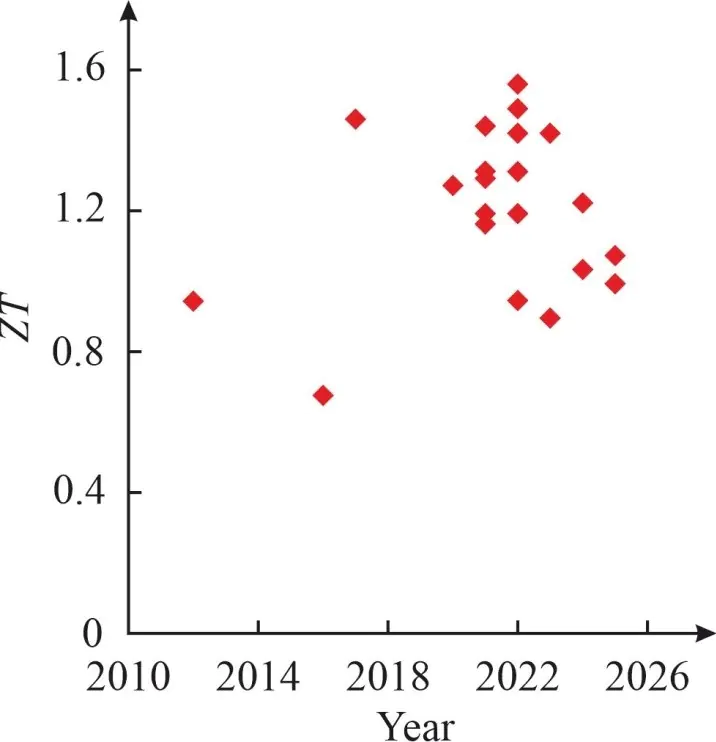
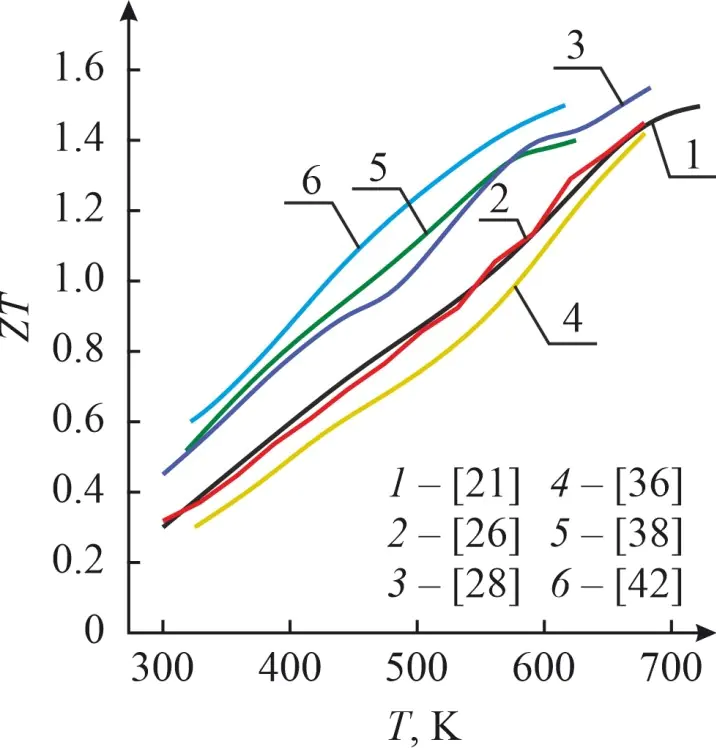
Tables 1 and 2 present the main parameters of Zn4Sb3-based thermoelectric materials achieved by various authors. Figure 1 presents the (ZT)max for Zn4Sb3-based thermoelectric materials. Research on this material has intensified significantly in recent years. Figure 2 presents promising compositions of Zn4Sb3-based thermoelectric materials with maximum ZT values.
The maximum operating temperature of this material is limited by the stability of the β-phase, for which high thermoelectric figure of merit values are observed.
Thus, several researchers have obtained high (ZT)max ranging from 1.40 to 1.57, with (ZT)av of up to 1.10 in the temperature range of 300–720 K. One of the main methods for producing thermoelectric materials that exhibit high values of thermoelectric figure of merit is SPS. At the same time, data have been presented on Zn4Sb3-based thermoelectric materials with record ZT values obtained using simple and, consequently, cost-effective technological approaches, which is important for industrial production. However, the authors have not fully considered the stability of the developed thermoelectric materials.
At the same time, the practical application of this thermoelectric material is limited by the fact that obtaining a single-phase material is rather difficult. Another significant problem is its thermal instability. Zn4Sb3 is susceptible to phase transitions (from the thermoelectrically active β-phase to the less favorable α-phase) or decomposition into ZnSb and elemental Zn at middle and high temperatures. In addition, some authors have reported insufficient mechanical strength of this material.
3. Materials on the basis of magnesium antimonides
In recent years, active research has been carried out on magnesium antimonide-based materials, which exhibit high thermoelectric parameters in the temperature range of 300–800 K. Thus, according to the classification adopted in thermoelectric technology, these materials belong to middle-temperature thermoelectric materials. Promising thermoelectric materials include n-type Mg3Sb2-based materials [43-70] and p-type MgAgSb and Mg3Sb2-based materials [71-86], which exhibit ZT values ranging from 0.6 to 2.0 over the specified temperature range. In addition, Mg3Sb2-based thermoelectric materials are non-toxic and low-cost materials [87, 88, 50-52].
Thermoelectric materials on the basis of Mg3Sb2 and Mg3Bi2 belong to Zintl phases and form solid solutions, which makes it possible to improve their thermoelectric properties over a wide temperature range. Mg3Sb2 crystallizes in a CaAl2Si2-type structure and includes a tetrahedrally coordinated anion layer [Mg2Sb2]2− and an octahedrally coordinated Mg2+ cation layer arranged along the c-axis [88, 89]. This is the reason for the high electrical properties and low lattice thermal conductivity, corresponding to the “phonon-glass–electron-crystal” concept [17].
The strategy for improving the thermoelectric performance of Mg3Sb2-based thermoelectric materials includes the selection of dopants, defect engineering, modification of the band structure, and optimization of the microstructure, including through the development of fabrication technologies of thermoelectric materials. Compositions with excess Mg and Sb exhibit higher thermodynamic stability. Magnesium excess provides n-type conductivity, while Sb excess provides p-type conductivity. The presence of stable Mg vacancies (VMg) determines p-type conductivity. The existence of intrinsic defects such as VMg requires the use of excess Mg to obtain n-type conductivity. In addition, achieving p-type conductivity in Mg3Sb2 requires an appropriate selection of dopants. At the same time, the features of the band structure provide higher thermoelectric performance of n-type Mg3Sb2 compared with the p-type material.
The use of p-type MgAgSb is limited to temperatures of 573 K due to structural instability. Above this temperature, the thermoelectric figure of merit sharply decreases due to the transition of α-MgAgSb into the β-phase, which exhibits metallic properties.
The high volatility of Mg represents a problem associated with reduced thermal and chemical stability. Upon contact with air, Mg is inclined to oxidation, and Ag may migrate. These issues require the use of surface protection or effective encapsulation to preserve the material properties. Finally, the inherent brittleness of the material complicates its use for the fabrication of thermoelements.
The SPS has been successfully applied for the fabrication of Mg3Sb2. Using co-doping with Sc and Te, n-type Mg3Sb2 materials with ZT values ranging from 0.40 to 1.56 in the temperature range of 300–725 K and (ZT)av = 0.90 were obtained by this method [43].
In [44], theoretical calculations and experimental studies of n-type thermoelectric materials based on Mg3Sb1.5Bi0.5 doped with Te were carried out. The best ZT values were obtained for the compositions Mg3Sb1.5–0.5xBi0.5–0.5xTex (x = 0.04, 0.05, 0.08), which were synthesized by the arc melting method followed by SPS. It was shown that for Mg3Sb1.48Bi0.48Te0.04, the values of ZT vary from 0.56 to 1.65 in the temperature range of 300–725 K. The value of (ZT)max = 1.65 was achieved at a temperature of 725 K.
In [45], various doping strategies for Mg3Sb2 were investigated. Computational modeling was performed to predict effective donor dopant elements from the lanthanide series. It was shown that, in addition to La, Ce, Pr, and Tm, a high electron concentration (≳1020 cm−3) is provided by Nd, Gd, Ho, and Lu, which substitute Mg sites. These dopants are even more effective than other lanthanides, as well as Te, which substitutes anions. The materials Mg3+δNdySb2-xTex (δ = 0.5, y = 0.01–0.04, x = 0, 0.03), Mg3+δTmySb2-xTex (δ = 0.5, y = 0.01–0.04, x = 0, 0.03), Mg3+δYySb2 (δ = 0.5, y = 0.01–0.04) were obtained by the SPS from powders of mixed initial components. The calculation results were experimentally confirmed by doping Mg3Sb2 with Nd and Tm impurities. A higher electron concentration and ZT were obtained compared with Te doping: (ZT)max = 1.30 at 775 K for Mg3.5Nd0.04Sb2; (ZT)max = 1.38 at 775 K for Mg3.5Tm0.03Sb2. However, the best results were achieved by co-doping with Nd and Te, as well as Tm and Te: (ZT)max = 1.65 at 775 K for Mg3.5Nd0.04Sb1.97Te0.03 and (ZT)max = 1.75 at 775 K for Mg3.5Tm0.03Sb1.97Te0.03.
In [46], n-type materials with the compositions Mg3.2Bi2-x-ySbxSey (x = 0.3, 0.5, 1, 1.5, 1.7, y = 0.004, 0.008, 0.012) were investigated. The powders of the initial components were subjected to mechanical alloying (MA) in a planetary ball mill at a speed of 450 rpm for 15 h. The obtained powder was compacted by the SPS at 973–1073 K and 50 MPa for 3 min. The values of (ZT)max = 1.27 and (ZT)max = 1.28 at temperatures of 550 and 750 K were achieved for Mg3.2Bi0.996SbSe0.004 and Mg3.2Bi0.296Sb1.7Se0.004, respectively. The value of (ZT)av = 1.05 was obtained for Mg3.2Bi0.996SbSe0.004, while the value of (ZT)av = 0.95 was obtained for Mg3.2Bi0.296Sb1.7Se0.004 in the temperature range of 300–700 K.
In [47], Mg3.2-xZnxSb1.5Bi0.49Se0.01 (x = 0, 0.01, 0.02, 0.04) was investigated. The material was obtained by MA in a ball mill for 10 h. Subsequently, the powder was subjected to HP at 1023 K and 60 MPa for 2 min. An increase in electrical conductivity due to enhanced charge carrier mobility upon Zn addition was observed. At the same time, thermal conductivity decreased. The values of (ZT)max = 1.77 at 623 K and (ZT)av = 1.24 in the temperature range of 300–673 K were obtained for Mg3.18Zn0.02Sb1.5Bi0.49Se0.01.
In [48], Mg3.2SbBi0.99Te0.01 with the addition of 0, 0.3, 0.5, and 0.7 wt.% carbon nanotubes was investigated. The initial materials Mg, Sb, Bi, and Te were subjected to MA in a ball mill for 6 h. Subsequently, carbon nanotubes were added to the ball mill and mixed for 12 min. Compacting was carried out by the HP at 1073 K and 80 MPa for 2 min. It was noted that the addition of carbon nanotubes led to a decrease in the lattice contribution to thermal conductivity due to the mismatch between the phonon spectra of Mg3.2SbBi0.99Te0.01 and carbon nanotubes. High values of (ZT)max = 1.50 at 573 K for nanocomposite Mg3(Sb, Bi)2 with 0.5 wt.% carbon nanotubes and (ZT)av = 1.14 in the temperature range of 323–573 K were obtained.
In [49], thermoelectric materials with the composition Mg3.2-xMoxSbyBi1.99-yTe0.01 were investigated. The introduction of Mo leads to an increase in the average grain size, which enhances carrier mobility and electrical conductivity. High-purity starting materials were used to produce the thermoelectric materials. The materials synthesized by MA were ground in a ball mill under an inert atmosphere for 5 h, then were compacted using the SPS at 973 K under a pressure of 60 MPa for 10 min. X-ray phase analysis confirmed the preservation of the trigonal α-Mg3Sb2 structure without the formation of secondary phases. Mapping performed using energy-dispersive spectroscopy revealed the segregation of Mo at grain boundaries in the form of triangular domains without its dissolution in the lattice, which increased the average grain size from 9.46 μm to 18.07 μm. As a result, the potential barrier for charge carriers at grain boundaries decreased from 46 to 8 meV, increasing carrier mobility from 42 to 96 cm2/(V·s) at 323 K and electrical conductivity up to 5.1·104 Ω-1·m-1 while maintaining the Seebeck coefficient of ~–290 μV/K at 723 K. The lattice thermal conductivity was 0.52 W/(m·K) at 723 K due to point defects (the difference in atomic radii of Sb/Bi is ~10%). As a result, the values of (ZT)max = 1.84 at 723 K and (ZT)av = 1.20 were obtained for the composition Mg3.16Mo0.04Sb1.4Bi0.59Te0.01. The composition Mg3.16Mo0.04Sb1.3Bi0.69Te0.01 has values of (ZT)max = 1.75 at 673 K and (ZT)av = 1.34 in the temperature range of 323–723 K. Based on the composition with the highest (ZT)av value, a thermoelectric leg was fabricated for a thermoelectric device, which demonstrated a very high conversion efficiency of ~12% at ΔT = 425 K. The article notes that for practical applications, it is necessary to ensure the prevention of Mg losses at high temperatures (through doping with heavy elements or protective coatings). It should be noted that in this work, along with high (ZT)max, very good values of (ZT)av were obtained, which is important for the fabrication of thermoelements operating over a wide temperature range.
In [50], the influence of In on the properties of magnesium antimonide was investigated. The complexity of the defect microstructure in Mg3Sb2 prevents the achievement of high performance. In this work, the defect microstructure was modified through the introduction of In and an increased annealing time. The reduction of structural disorder ensured improved electron transport. The thermoelectric materials were synthesized in a high-energy ball mill for 5 h and then compacted by the SPS at a pressure of 60 MPa and a temperature of 700 K with different sintering times ranging from 10 to 30 min. As a result, for the thermoelectric material Mg3.2In0.005Sb1.5Bi0.49Te0.01, a high carrier mobility of ~174 cm2/(V·s), a high Seebeck coefficient value of –290 μV/K, and a minimum lattice thermal conductivity κlat = 0.42 W/(m·K) were obtained. A record high value of (ZT)max = 2.00 at 723 K was achieved and, equally important, value of (ZT)av = 1.36 was obtained in the range of 300–723 K. Thermoelectric modules were fabricated using contact layers made of Mg and stainless steel. The module based on Mg3Sb2/MgAgSb achieved an efficiency of ~7.1% at ΔT = 276 K.
High values of the thermoelectric figure of merit were obtained by a number of authors through yttrium doping of magnesium antimonide. In most cases, the thermoelectric materials were obtained by MA followed by HP [51, 52] or SPS [53].
In [51], n-type Mg3SbBi doped with yttrium was investigated. The synthesis was carried out by the direct melting method of the components at 1373 K for 4 h, followed by annealing at 923 K for 72 h. Then, HP was performed at 823 K and 110 MPa for 25 min. Y doping provided an increase in the electron concentration to values exceeding 1020 cm–3. As a result, the values of (ZT)max = 1.80 at 700 K and (ZT)av = 1.35 in the temperature range of 300–750 K were obtained.
In [52], Mg3+xYySb1.5Bi0.5 with x = 0, 0.02, and 0.04, and y = 0.02, 0.03, 0.035, and 0.04 was investigated. The samples were obtained by MA for 10 h and compacted by the HP method at 1023 K for 2 min. Y doping increased both the charge carrier mobility and their concentration. The thermal conductivity of the thermoelectric materials at 773 K was 0.7–0.8 W/(m·K). The value of (ZT)max = 1.78 at 773 K was achieved for Mg3.02Y0.02Sb1.5Bi0.5.
In [53], n-type Mg3+δ(Sb,Bi)2 was investigated. First-principles calculations showed that the substitution of magnesium ions with Y ions shifts the Fermi level and simultaneously reduces the band gap width. The material was obtained by MA at 550 rpm for 5 h. Then, SPS was carried out at 773 K and 50 MPa for 5 min, followed by heating to 923 K and holding for 5 min. The value of (ZT)max = 1.87 at 773 K was achieved for Mg3.18Y0.02Sb1.5Bi0.49Se0.01.
The thermoelectric properties of p-type Mg3Sb2 are generally inferior to those of n-type Mg3Sb2. However, effective p-type Mg3Sb2 materials are actively being developed, as they are important for the designing of thermoelements on basis of a single thermoelectric material. Progress in the development of p-type Mg3Sb2 has been achieved through optimization of carrier concentration, carrier mobility, and reduction of lattice thermal conductivity. In particular, co-doping with Na and Y in Mg1.8Zn1.2Sb2 enabled the achievement of (ZT)max = 0.70 at 573 K [71]. Co-doping with Ag and Zn increases the concentration and mobility of charge carriers, and consequently the PF. The large difference in atomic masses of Zn and Mg provides a reduction in lattice thermal conductivity. As a result, the values of (ZT)max = 0.89 and (ZT)max = 0.84 at 773 K were obtained for Na0.01Mg1.7ZnYb0.25Sb2 and Mg2.39Zn0.6Ag0.01Sb2, respectively [72, 73]. For the complex structure (Mg3.07Ag0.03Sb2)0.5(YbZn1.2Cd0.8Sb2)0.5, using MA and HP, a value of (ZT)max = 1.34 was obtained at a temperature of 773 K [74], which is close to the (ZT)max for n-type thermoelectric materials. At the same time, the value of (ZT)av in the temperature range of 323–773 K is 0.77. This is the best known p-type material with a wide operating temperature range.
In [75], a thermoelectric material on the basis of α-MgAgSb was investigated, which is a p-type semiconductor up to 573 K. In the temperature range of 573–643 K, MgAgSb has the β-phase and exhibits metallic properties. Above 643 K, γ-MgAgSb has a half-Heusler structure and exhibits semiconducting properties. MA of MgAg0.97Sb0.99 was carried out in a high-energy ball mill for 5–20 h. Subsequently, the powder was compacted by the SPS at 573 K and 60 MPa for 5 min, followed by annealing at 573 K for 6 h. The value of (ZT)max = 1.36 at 473 K was obtained for the sample synthesized for 20 h.
The work [76] is noteworthy, in which high values of (ZT)av = 1.31 and (ZT)max = 1.50 were achieved for MgAgSb in the temperature range of 300–573 K, with a maximum operating temperature of 573 K. The thermoelectric material was obtained using MA and HP. In [77], within a limited temperature range of 300–500 K, the values of (ZT)max = 1.35 and (ZT)av = 1.10 were obtained for MgAg0.97Sb0.99 fabricated using HP.
In [78], MgAg0.97Sb0.99 and MgAg0.965Ni0.005Sb0.99 were investigated. To obtain MgAg, MA of the powders was carried out for 8 h, followed by the addition of Sb and continuation of MA for another 5 h. To obtain bulk samples, HP of the powders was performed at 575 K for 30 min. The grain size in the obtained material was less than 20 nm. The small grain size combined with point defects, including vacancies in the structure, are the main reasons for the low thermal conductivity of ~0.8 W/(m·K). The value of (ZT)max = 1.37 at 475 K was achieved for MgAg0.965Ni0.005Sb0.99. In [79], MgAg0.97-xCuxSb0.99 (x = 0, 0.003, 0.007 and 0.01) was investigated. The material was synthesized similarly to [78] with MA durations of 10 and 8 h, respectively. HP of the powders was carried out at 573 K for 5 min. The substitution of Ag atoms by Cu resulted in a reduction of lattice thermal conductivity. According to the results, the PF also increased. The value of (ZT)max = 1.32 at 523 K was achieved for MgAg0.963Cu0.007Sb0.99.
In [80], α-MgAgSb was obtained by two methods. In the first case, the material was synthesized by direct melting at 1273 K for 10 h in a tantalum ampoule, which was placed in a quartz ampoule. SPS was carried out at 723 K and 60 MPa for 5 min. Then, the sample was annealed at 563 K for 2 weeks. In the second case, MA of MgAg was performed for 5 h and MgAgSb for 10 h. Compaction was carried out at 573 K and 90 MPa for 30 min. Then annealing at 563 K for 5 days was performed. The sample obtained by direct melting contained less oxygen and had larger grain sizes. As a result, the values of (ZT)max = 1.27 at 500 K and (ZT)av = 1.10 in the temperature range of 300–550 K were achieved.
In [81], α-MgAgSb was investigated. MA was carried out at 1425 rpm for 8 h for MgAg0.97 and subsequently for 8 h for MgAg0.97Sb. SPS of the powders was performed at a pressure of 80 MPa and temperatures of 573 and 673 K. The samples were then annealed at 553 K for 3 days. The value of (ZT)max = 1.27 at 500 K was achieved.
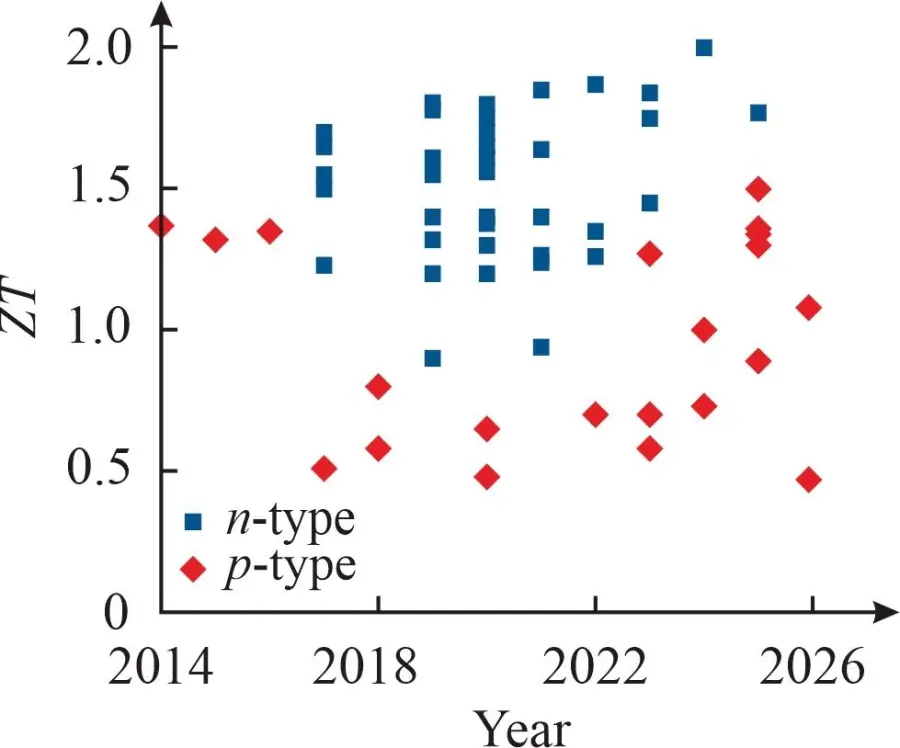
The main parameters obtained by various authors for thermoelectric materials on the basis of magnesium antimonides are presented in Tables 3 and 4. Figure 3 presents the (ZT)max for n- and p-type Mg3Sb2-based thermoelectric materials obtained in 2014–2026. As can be seen from Fig. 3, significant progress has been achieved for n-type Mg3Sb2-based materials. The achievements in obtaining p-type thermoelectric materials are considerably lower. However, higher ZT values have also been obtained compared with thermoelectric materials with similar operating temperatures that are currently used.
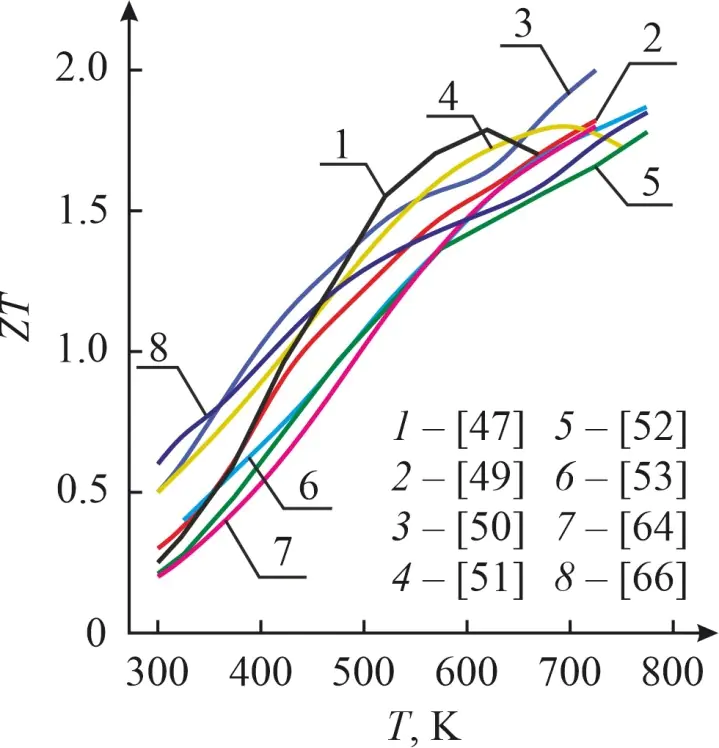
Figure 4 presents the temperature dependences of ZT for the most promising compositions of n-type Mg3Sb2-based thermoelectric materials. Figure 5 presents the temperature dependences of ZT for p-type Mg3Sb2-based thermoelectric materials with the highest thermoelectric figure of merit. Analyzing the achievements in the development of magnesium antimonide-based materials, the following should be noted. N-type Mg3Sb2-based materials are promising middle-temperature thermoelectric materials in the temperature range of 300–800 K (Fig. 4). The efficiency of p-type materials is significantly lower and is observed in a limited temperature range (Fig. 5).
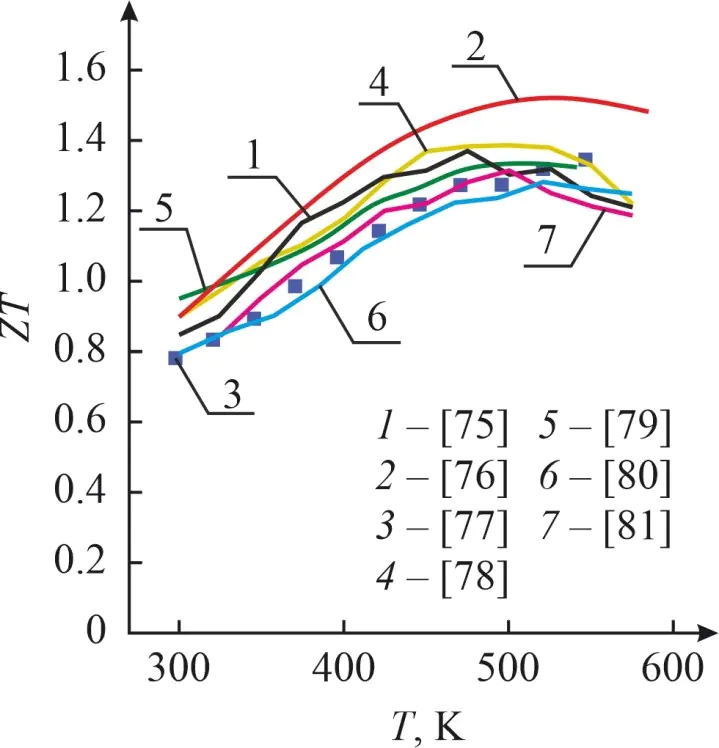
Thus, the features of the band structure provide higher thermoelectric properties of n-type Mg3Sb2 compared with p-type Mg3Sb2. However, effective p-type Mg3Sb2 materials are actively being developed, as this is important for the designing of thermoelectric devices entirely based on a single thermoelectric material.
The best results correspond to values of (ZT)max ranging from 1.65 to 2.00 for n-type materials. At the same time, the values of (ZT)av for these thermoelectric materials in the temperature range of 300–723 K are 1.36, and in the range of 300–800 K – 1.20. These are very high values, which are generally observed for thermoelectric materials obtained by MA and compacted using SPS and HP.
Unfortunately, the thermoelectric figure of merit values of p-type MgAgSb-based materials are considerably lower and do not exceed (ZT)max = 1.50 with (ZT)av = 1.31 in the temperature range of 300–573 K. The main fabrication methods correspond to those used for n-type materials.
The following main advantages of the mentioned thermoelectric materials should be noted: the possibility of composition modification to obtain both n-type and p-type conductivity, and flexibility in controlling the operating temperature range to achieve high thermoelectric properties. It is important to emphasize the economic aspect due to the absence of expensive components (although small amounts of Te are sometimes introduced to improve performance).
Overall, despite the undoubted advantages, Mg3Sb2 has several disadvantages. Structural disorder often leads to the formation of complex secondary phases, especially in samples synthesized using a planetary ball mill. This complicates the targeted optimization of material properties. To eliminate these disadvantages, it is necessary to use a comprehensive approach in the development of thermoelectric material technology, including careful control of the synthesis process, optimization of the microstructure, and defect engineering. For example, the proposed low-temperature annealing allows effective control of nonequilibrium defects and improves material stability. Experimental and theoretical studies also show that the thermal stability of the material can be significantly improved by filling vacancy defects with transition metals rather than excess Mg. This increases the strength of chemical bonds and enhances the defect formation energy, thereby reducing intrinsic instability and contributing to improved long-term thermoelectric performance.
However, despite the aforementioned disadvantages, magnesium antimonide-based thermoelectric materials are among the most promising materials for active research aimed at their industrial application in the fabrication of medium-temperature thermoelements.
Conclusion
Zinc antimonide is a promising thermoelectric material for the fabrication of p-type thermoelement legs in TEGs. High value of (ZT)max ranging from 1.40 to 1.57 have been obtained, with the value of (ZT)av reaching up to 1.10 in the temperature range of 300–720 K. One of the main methods for obtaining thermoelectric materials that provides high thermoelectric figure of merit is SPS. The absence of expensive and toxic elements, such as Te, which is one of the main components of currently used thermoelectric materials, enhances the economic advantages and environmental friendliness of Zn4Sb3. This determines its high potential for widespread application in thermoelectric technology. However, the practical use of this thermoelectric material is limited by the difficulty of obtaining a single-phase material. Thermal instability is also a significant problem.
N-type and p-type Mg3Sb2-based thermoelectric materials are promising middle-temperature thermoelectric materials. The values of (ZT)max ranging from 1.65 to 2.00 have been obtained for n-type thermoelectric materials, with values of (ZT)av = 1.36 in the temperature range of 300–723 K and (ZT)av = 1.20 in the range of 300–800 K. These are very high values, which are generally observed for thermoelectric materials obtained by MA and compacted using SPS and HP. The thermoelectric figure of merit values of p-type MgAgSb-based materials are considerably lower and do not exceed (ZT)max = 1.50 with (ZT)av = 1.31 in the temperature range of 300–573 K. The main fabrication methods correspond to those used for n-type materials. The practical application of Mg3Sb2-based thermoelectric materials is limited by the structural disorder of Mg3Sb2, which often leads to the formation of complex secondary phases. This complicates the optimization of thermoelectric material properties. The use of p-type MgAgSb is limited to temperatures up to 573 K due to structural instability. Finally, the inherent brittleness of the material complicates its use for thermoelement fabrication. However, despite these disadvantages, magnesium antimonide-based thermoelectric materials are among the most promising materials for industrial application in middle-temperature thermoelements. The high cost-effectiveness of Mg3Sb2-based thermoelectric materials is determined by the absence of expensive components.
It should be noted that the thermoelectric figure of merit of Mg3Sb2- and Zn4Sb3-based thermoelectric materials in the temperature range of 300–400 K is inferior to this parameter for bismuth and antimony tellurides. Therefore, in order to increase the efficiency of medium-temperature generator thermoelements operating in the temperature range of 300–700 K, they should be fabricated as two-section structures: low-temperature sections on the basis of BiTeSe for the n-type leg and BiSbTe for the p-type leg, as well as middle-temperature sections on the basis of n-type Mg3Sb2 and p-type Zn4Sb3 conductivities.
Acknowledgements
This work was supported by the Russian Science Foundation (project No. 25-13-90003).
References