

Keywords
Abstract
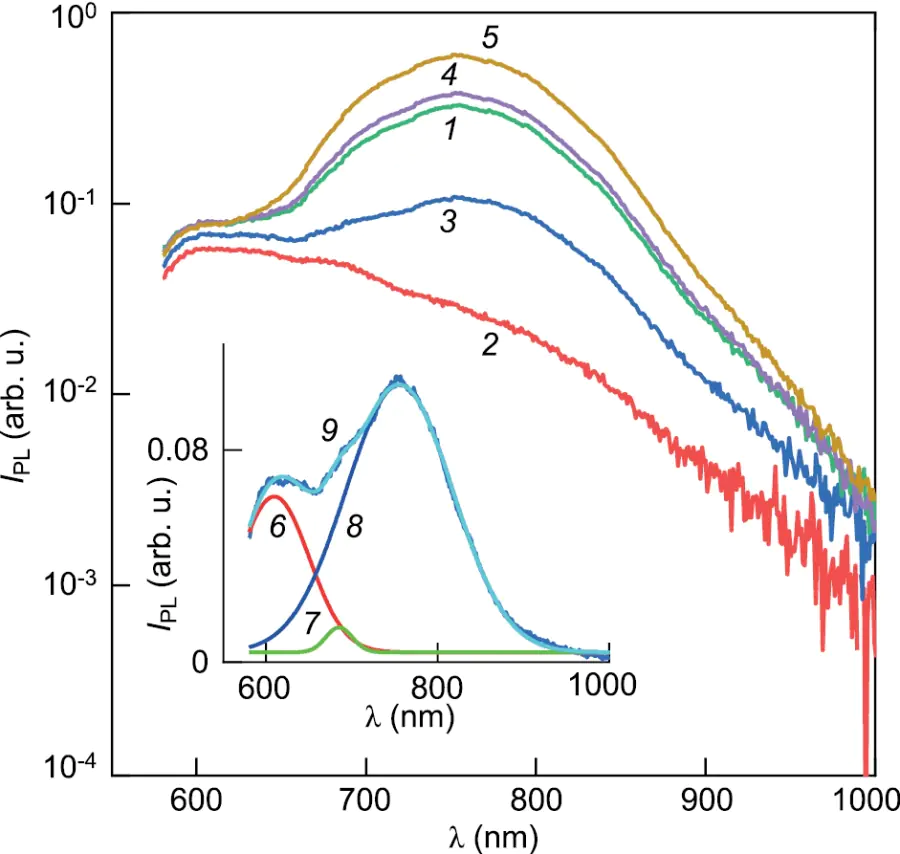
The effect of rapid thermal annealing (RTA) at 950 and 1000 °C for 3 min on the photoluminescence (PL) in multilayered (~50 layers) nanoperiodical (4/3 nm) a-SiOx/SiO2 and a-SiOx/ZrO2 nanostrucutres (MNS) synthesized using vacuum evaporation has been analyzed in comparison with conventional long-term (~1 h) high-temperature annealing (HTA). It has been shown that the use of sequential anneals (RTA + HTA) at 1000 and 1100 °C, respectively, allows increasing the intensity of the PL band of silicon nanocrystals (at ~800 nm) by 2.5 times as compared with conventional heat treatment. Analysis of the PL spectra suggests that RTA triggers the formation of chain and ring non-phase silicon inclusions and/or small-sized Si nanocrystals (~2 nm) which generate radiation near 600 nm at room temperature. Thus, one can conclude that RTA produces elevated concentrations of the abovementioned silicon nuclei which, upon subsequent HTA, serve as growth centers for larger Si nanocrystals (~3–4 nm). It has been found that SiOx/ZrO2 MNS exhibit a similar behavior (qualitative) of PL spectra after RTA. However, the PL intensity in this case is 5–10 times lower, due to the chemical interactions between the materials of the MNS layers with the formation of zirconium silicides and silicates.