

Home / Articles / Propylene carbonate based organic electrolytes for supercapacitors used in portable electronics power sources  

Propylene carbonate based organic electrolytes for supercapacitors used in portable electronics power sources  

0
Share
Cite this
GOST
 | 
Cite this
GOST
Stakhanova S. V. et al. Propylene carbonate based organic electrolytes for supercapacitors used in portable electronics power sources // Modern Electronic Materials. 2026. Vol. 12. No. 2. pp. 71-82.
GOST all authors (up to 50)
Stakhanova S. V., Puntusova L. A., Gurchenkova L. A., Shmakova E. V., Krechetov I. S., Kozhitov L. V. Propylene carbonate based organic electrolytes for supercapacitors used in portable electronics power sources // Modern Electronic Materials. 2026. Vol. 12. No. 2. pp. 71-82.
RIS
 | 
Cite this
RIS
TY - JOUR
DO - 10.3897/j.moem.12.2.205799
UR - https://moem.colab.ws/publications/10.3897/j.moem.12.2.205799
TI - Propylene carbonate based organic electrolytes for supercapacitors used in portable electronics power sources
T2 - Modern Electronic Materials
AU - Stakhanova, Svetlana V.
AU - Puntusova, Lyudmila A.
AU - Gurchenkova, Lidiya A.
AU - Shmakova, Elizaveta V.
AU - Krechetov, Ilya S.
AU - Kozhitov, Lev V.
PY - 2026
DA - 2026/06/30
PB - НИТУ МИСИС
SP - 71-82
IS - 2
VL - 12
ER -
BibTex
 | 
Cite this
BibTex (up to 50 authors)
@article{2026_Stakhanova,
author = {Svetlana V. Stakhanova and Lyudmila A. Puntusova and Lidiya A. Gurchenkova and Elizaveta V. Shmakova and Ilya S. Krechetov and Lev V. Kozhitov},
title = {Propylene carbonate based organic electrolytes for supercapacitors used in portable electronics power sources },
journal = {Modern Electronic Materials},
year = {2026},
volume = {12},
publisher = {НИТУ МИСИС},
month = {Jun},
url = {https://moem.colab.ws/publications/10.3897/j.moem.12.2.205799},
number = {2},
pages = {71--82},
doi = {10.3897/j.moem.12.2.205799}
}
MLA
Cite this
MLA
Stakhanova, Svetlana V., et al. “Propylene carbonate based organic electrolytes for supercapacitors used in portable electronics power sources .” Modern Electronic Materials, vol. 12, no. 2, Jun. 2026, pp. 71-82. https://moem.colab.ws/publications/10.3897/j.moem.12.2.205799.
Views / Visits / Downloads
159 / 153 / 482

Keywords

1,1-dimethylpirrolidinium tetrafluoroborate
energy storage systems
portable electronics devices
propylenecarbonate
rechargeable power sources
spiro-(1,1’)-bipyrrolidinium tetrafluoroborate
supercapacitor

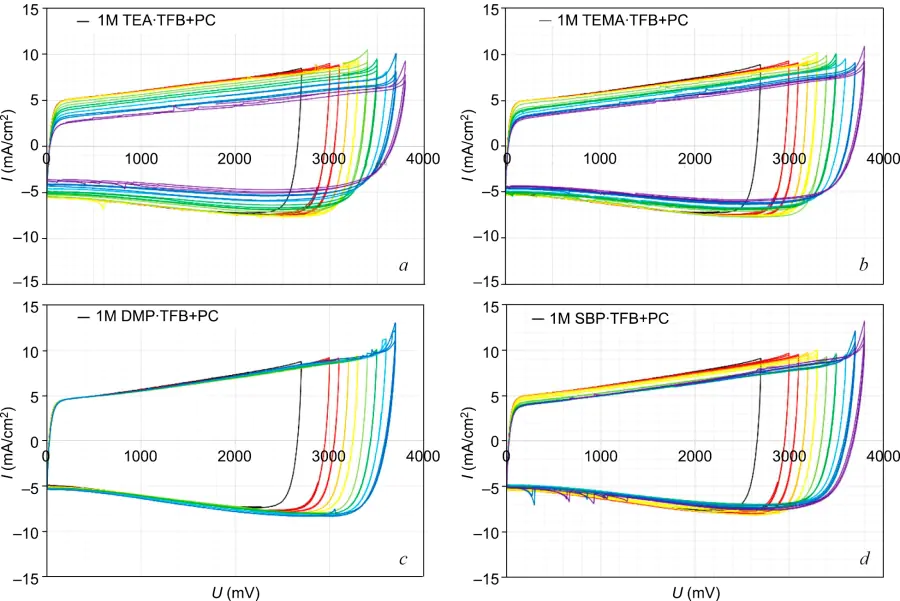
Abstract

Results of a systematic study of propylene carbonate (PC) based organic electrolytes with alkylammonium tetrafluoroborates for use in supercapacitors (SC) for portable electronics and self-charging power sources have been presented. The importance of the study is dictated by the requirement to combine SC high power capacity, electrochemical stability over a wide temperature range, and operation safety, especially in independent miniaturized devices. Unlike acetonitrile (AN) conventionally used in SC electrolytes, PC is not noxious and non-flammable, but its high viscosity limits the electrical conductivity of electrolytes thus making the choice of optimum ionogenic salt a critical task. The properties of PC-based electrolytes with tetraethylammonium (TEA·TFB), methyltriethylammonium (TEMA·TFB), spiro-(1,1’)-bipyrrolidinium (SBP·TFB), and 1,1-dimethylpirrolidinium (DMP·TFB) tetrafluoroborates, differing in the size and structure of cations (acyclic and cyclic) have been studied. All the test salts deliver approximately similar capacities of SC cells, but TEA·TFB demonstrates somewhat lower capacity due to the large size of its cation. Ionogenic salts with cyclic cations (SBP·TFB and, especially, DMP·TFB) provide a far greater range of operation voltage at elevated temperatures to 85 °C, whereas TEA·TFB and TEMA·TFB electrolytes degrade at above 60 °C. Durability tests (up to 70,000 cycles at 50–95 °C) confirmed the electrochemical and thermal stability of DMP·TFB+PC: SC cells with the latter electrolyte retain 80 % of initial capacity after 50,000 cycles of galvanostatic charging/discharging (GCD) and provide for an operation voltage of 3.0 V. The recommended operation temperature range for SC with DMP·TFB+PC electrolyte is 0 to 85 °C, with the possibility of short-time temperature growth to 95 °C, whereas at below 0 °С the growing viscosity of the electrolyte causes a dramatic degradation of SC capacity. Thus, DMP·TFB+PC electrolyte is promising for SC used in portable electronics.