

Home / Articles / 1.534 µm Er electroluminescence in the RF magnetron deposited In2O3 : Er films on a Si substrate  

1.534 µm Er electroluminescence in the RF magnetron deposited In2O3 : Er films on a Si substrate  

,  ,  ,  , 
Alexey M. Pugachev 6
Alexey M. Pugachev
,  ,  ,  ,  , 
Leonid N. Safronov 5
Leonid N. Safronov
, 
Sergey A. Kochubey 5
Sergey A. Kochubey
,  , 
Aleksandr V. Kapishnikov
,  , 
Alexander A. Shklyaev
, 
Yuriy A. Zhivodkov 5
Yuriy A. Zhivodkov
1 Rzhanov Institute of Semiconductor Physics Siberian Branch of Russian Academy of Sciences, Novosibirsk, Russia
2 Academ Infrared LLC, Novosibirsk, Russia
4 Synchrotron Radiation Facility “SKIF”, Koltsovo, Russia
5 Rzhanov Institute of Semiconductor Physics Siberian Branch of Russian Academy of Sciences, Novosibirsk, Russia
6 Institute of Automation and Electrometry, Siberian Branch of the Russian Academy of Sciences, Novosibirsk, Russia
Published 30 June 2026
0
Share
Cite this
GOST
 | 
Cite this
GOST
Feklistov K. V. et al. 1.534 µm Er electroluminescence in the RF magnetron deposited In2O3 : Er films on a Si substrate // Modern Electronic Materials. 2026. Vol. 12. No. 2. pp. 95-102.
GOST all authors (up to 50)
Feklistov K. V., Lemzyakov A. G., Abramkin D. S., Svit K. A., Pugachev A. M., Volodin V. A., Marin D. V., Spesivsev E. V., Azarov I. A., Safronov L. N., Kochubey S. A., Ershov K. S., Kapishnikov A. V., Shmakov A. N., Shklyaev A. A., Zhivodkov Y. A. 1.534 µm Er electroluminescence in the RF magnetron deposited In2O3 : Er films on a Si substrate // Modern Electronic Materials. 2026. Vol. 12. No. 2. pp. 95-102.
RIS
 | 
Cite this
RIS
TY - JOUR
DO - 10.3897/j.moem.12.2.205390
UR - https://moem.colab.ws/publications/10.3897/j.moem.12.2.205390
TI - 1.534 µm Er electroluminescence in the RF magnetron deposited In2O3 : Er films on a Si substrate
T2 - Modern Electronic Materials
AU - Feklistov, Konstantin V.
AU - Lemzyakov, Alexey G.
AU - Abramkin, Demid S.
AU - Svit, Kirill A.
AU - Pugachev, Alexey M.
AU - Volodin, Vladimir A.
AU - Marin, Denis V
AU - Spesivsev, Evgeny V.
AU - Azarov, Ivan A.
AU - Safronov, Leonid N.
AU - Kochubey, Sergey A.
AU - Ershov, Kirill S.
AU - Kapishnikov, Aleksandr V.
AU - Shmakov, Alexander N.
AU - Shklyaev, Alexander A.
AU - Zhivodkov, Yuriy A.
PY - 2026
DA - 2026/06/30
PB - НИТУ МИСИС
SP - 95-102
IS - 2
VL - 12
ER -
BibTex
 | 
Cite this
BibTex (up to 50 authors)
@article{2026_Feklistov,
author = {Konstantin V. Feklistov and Alexey G. Lemzyakov and Demid S. Abramkin and Kirill A. Svit and Alexey M. Pugachev and Vladimir A. Volodin and Denis V Marin and Evgeny V. Spesivsev and Ivan A. Azarov and Leonid N. Safronov and Sergey A. Kochubey and Kirill S. Ershov and Aleksandr V. Kapishnikov and Alexander N. Shmakov and Alexander A. Shklyaev and Yuriy A. Zhivodkov},
title = {1.534 µm Er electroluminescence in the RF magnetron deposited In2O3 : Er films on a Si substrate },
journal = {Modern Electronic Materials},
year = {2026},
volume = {12},
publisher = {НИТУ МИСИС},
month = {Jun},
url = {https://moem.colab.ws/publications/10.3897/j.moem.12.2.205390},
number = {2},
pages = {95--102},
doi = {10.3897/j.moem.12.2.205390}
}
MLA
Cite this
MLA
Feklistov, Konstantin V., et al. “1.534 µm Er electroluminescence in the RF magnetron deposited In2O3 : Er films on a Si substrate .” Modern Electronic Materials, vol. 12, no. 2, Jun. 2026, pp. 95-102. https://moem.colab.ws/publications/10.3897/j.moem.12.2.205390.
Views / Visits / Downloads
134 / 134 / 59

Keywords

band structure
electroluminescence
electrons
erbium
heterostructure
holes
indium oxide
silicon
thin films

Abstract

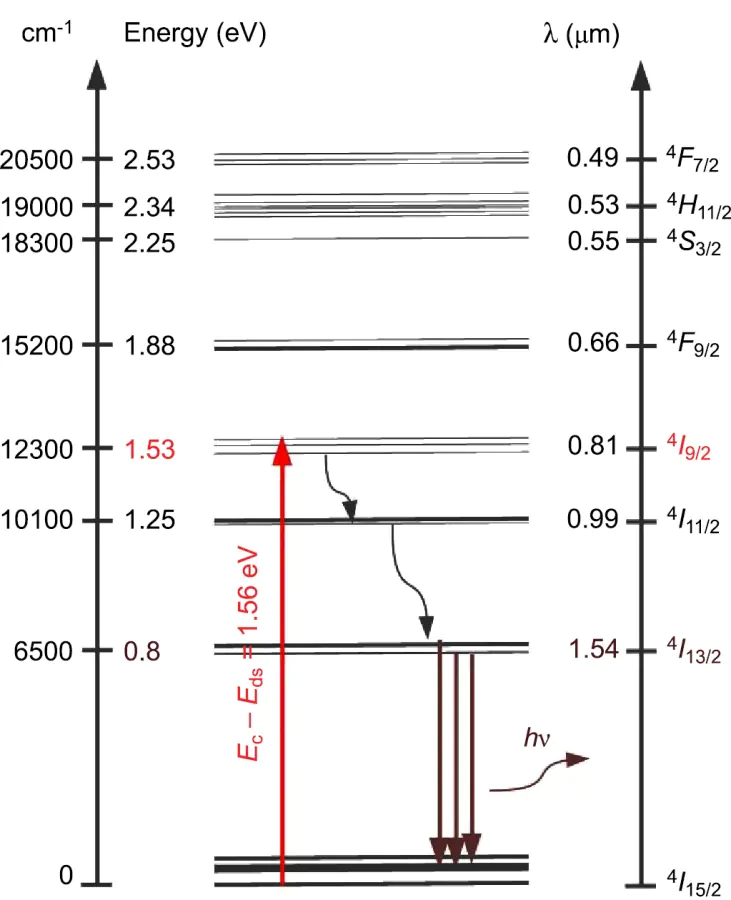
In2O3 : Er films were synthesized on silicon substrates by the RF magnetron sputter deposition. The solid solution ((In1-xErx)2O3) is formed here. The 1.534 µm erbium electroluminescence is observed by the current through the investigated heterostructure substrate-n-Si\In2O3 : Er-film\ITO-contact. The Er excitation model by the electron-hole recombination is proposed as follow. The electron current flows at the indium oxide conduction band. And the hole current flows at the channel in the middle of the In2O3 : Er bandgap. The hole channel is formed by the defect state density spreading from the valence band edge into the bandgap. Therefore the electron-hole recombination energy is lower than the indium oxide bandgap and equals to the 1.56 eV. Then the electron-hole recombination excites in resonance the third excited state of Er3+ 4I9/2 (1.53 eV). Then the nonradiative relaxation to the first excited state 4I13/2 (0.81 eV) occurs. And finally the 1.534 µm radiative emission into ground state 4I15/2 occurs.