


Keywords
Abstract
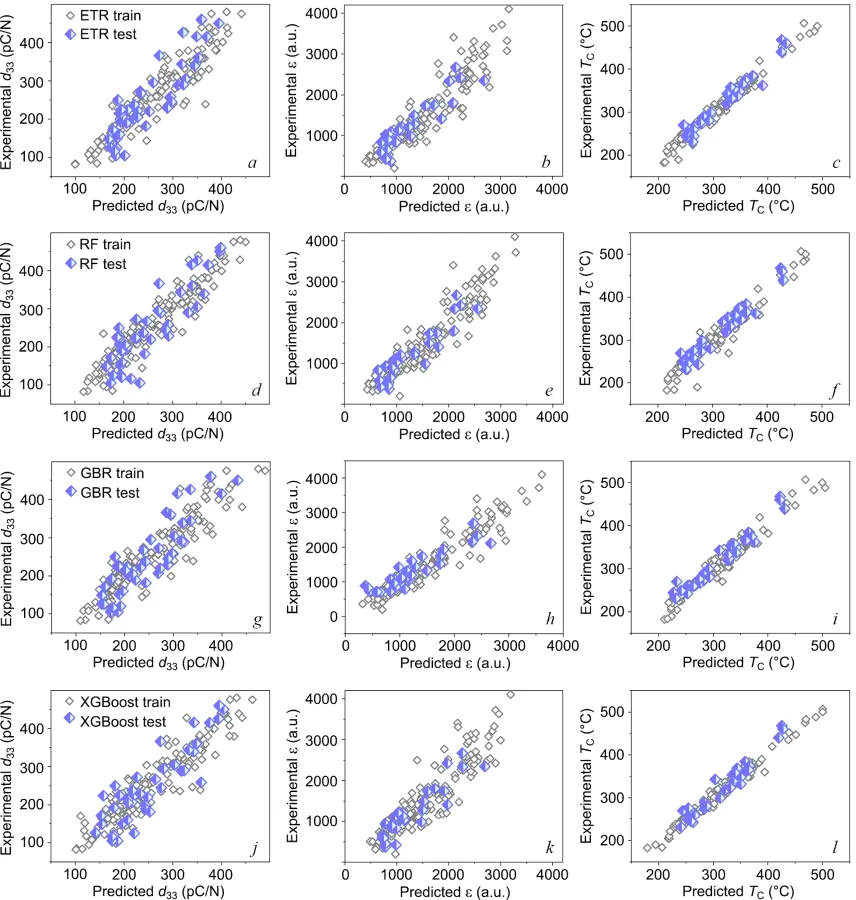
This work puts forward an interpretable approach for predicting ferroelectric properties on the basis of sure independence screening and sparsifying operator (SISSO) method, which uses a symbol regression for studying mathematically compact expressions having explicit physical sense. In combination with ensemble machine learning (ML) methods, i.e., extra trees regressor (ETR), random forest (RF), gradient boosting regressor (GBR), and extreme gradient boosting (XGBoost), as well as SHAP (SHapley Additive exPlanations) analysis for the selection and interpretation of features, the approach developed in this work simultaneously delivers high prediction accuracy and possibility to study fundamental mechanisms underlying the formation of ferroelectric properties in materials. Based on the available experimental data for 476 potassium-sodium niobate (KNN-based) ceramic specimens, feature engineering has been carried out, as a result of which the key physical descriptors have been separated and the optimal choice of predictors has been determined. The model developed herein allows explicit, i.e., in a formularized form, description of quantitative relationships between structural parameters and functional characteristics of materials. The methodological approach to interpretable machine learning put forward in this work opens up new possibilities for the optimization-driven design of piezoelectric ceramics and other functional materials, and will be useful both for fundamental research and practical applications.