


Keywords
Abstract
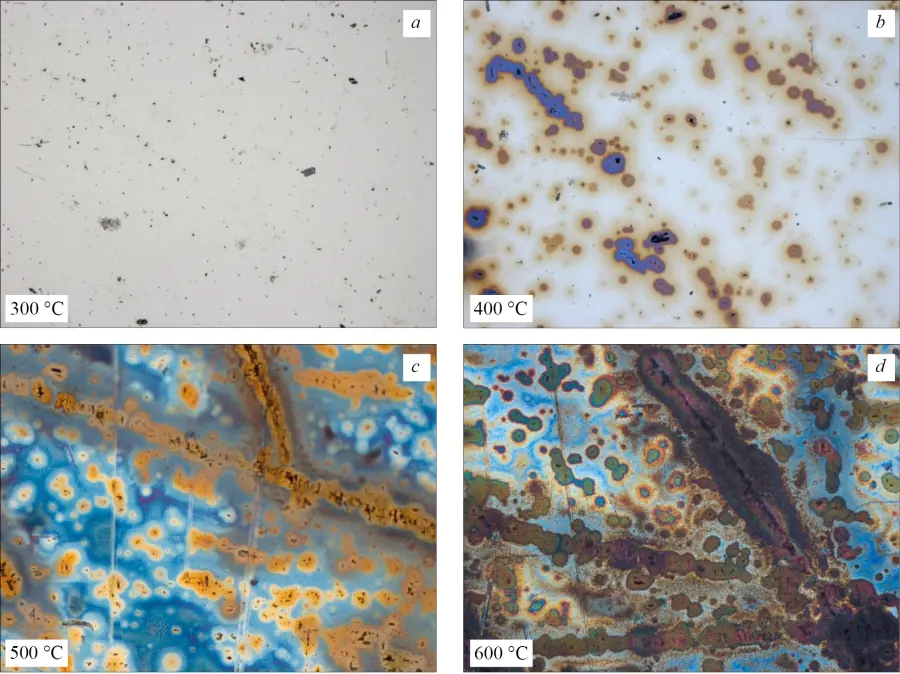
Reliable electrical contacts are essential for high-temperature piezoelectric devices based on lithium niobate (LiNbO3, LN), yet the behavior of electrode materials under elevated temperatures remains insufficiently studied. Here we evaluate three practical electrode systems on bidomain LN (BLN) substrates: screen-printed Pd thick films, sputtered indium–tin oxide (ITO), and sputtered nichrome (80 wt.% Ni and 20 wt.% Cr). Bidomain LN crystals function as single-crystal piezoelectric bimorphs with well-defined bending resonances, enabling sensitive impedance-based detection of electrode degradation. Impedance spectra were recorded in 100 °C increments up to 800 °C, complemented by microstructural inspection, electrical resistivity measurements, and X-ray photoelectron spectroscopy. Pd thick films showed the highest stability, with unchanged impedance spectra after heating to 800 °C and cooling. Indium–tin oxide electrodes remained functional up to at least 700 °C, with possible operation at 800 °C. X-ray photoelectron spectroscopy results suggest gradual incorporation of Nb from the BLN substrate which may initiate slow degradation in ITO. NiCr electrodes showed degradation of electrical contact near 500 °C due to oxide formation, while intrinsic electrical degradation associated with loss of film continuity occurred above 600 °C. These results identify Pd as a robust but costly choice, ITO as a promising mid-range alternative, and NiCr as suitable only within a lower high-temperature window.